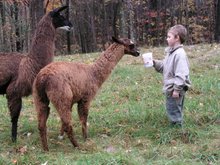
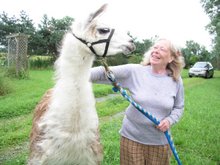
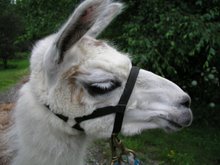
The last day of summer, how depressing (like we had a summer). Wooly Caterpillars are saying long cold winter (when isn't it). :) In the last week, we have met some great people and gotten some new animals in. Last week we had a call on a wild turkey that got hit near Howe Caverns. That didn't end well but it didn't go to waste; the foxes left little to tell what they had done. I met some great folks when I picked up the turkey, they have alpacas and they visited this weekend to meet the three alpacas that I have available for adoption. In the process, I am hoping that we might be able to get the building materials we need to get the raptor flight started before the snow flies. Connections and destiny ... time will tell.
I have another "raccoon friend" I am hoping will help us get a pond in for rehabbing beaver and geese/ ducks that come in. Again ... time will tell.
Some great students from the SUNY Cobleskill Wildlife Program found a goldfinch with a wing mutation on a hike. The bird is unreleasable and must have been fed by parents, a luxury that will end soon with their migration. Good deed done, and I have a student that may want to do an internship with me in the process.
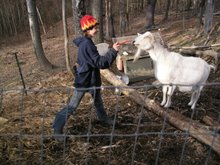
Saturday, I took the donkeys, alpacas, some other critters looking for homes, with some Raptors, to the Irish Festival at the Ballston Spa /Saratoga Co. Fairgrounds. It was a great day; the birds were a big hit and we got a chance to educate a lot of people about wildlife. It really doesn't get any better than that. Our donation jar did well and the people were very interested in what we do. Our educational events are vital to what we do and I hope we can book more events next year.
Yesterday, I had a great group of students come in for a tour of NY Wildlife Rescue Facility. They are a 4H group from Delhi, asked great questions, were respectful and want to help out in the future. I really like kids and animals; I love educating kids about wildlife conservation. 4H is such a valuable club for young people to be involved in. Anything that doesn't involve being stuck inside the house on a computer should be promoted. Their generation will see some horrible things environmentally; they will be the generation to, hopefully, go green.
I also have spent a lot of time the last week on paperwork. I hate it, but it is a necessity to keep good records for the various agencies that license me. Doing reports at the end of the year is easy when you have kept good records all year.
Last night, I actually took off my boots at 8:30 pm. The phone rang about 5 minites later. I recognized the number on caller ID, "New York Wildlife Rescue Center, this is Wes".... "This is Trooper (such and such) of the NY State Police, do you rescue coyotes?" Ten minutes later I was wrestling around in a ditch with it. I appreciate that he called me rather than just shooting it on the spot. I know a lot of people would rather it had been killed but I am a rehabber, not God. I don't rescue animals that I like and leave others to die.
The only thing that I could think of as I was grabbing it with my catch pole was that a dart would have been nice. That was the reason I took the chemical capture class at Tufts this summer. One of these days I am going to get a call for something bigger than me. I also thought about Oscar the bobcat; I bet that he felt the exact same way. Eyes in spotlights, blue and red lights, the sounds and smell of man ... and being helpless to move. I took the coyote to Cobleskill Vet Clinic where we knocked her out, did an exam and administered steroids. She is trying to get on her haunches but has a lower spine inflammation. I am trying to get her back in for an x-ray so I can figure out if we can really save her or if it would be more humane to put her down. I have never rescued a coyote before, a lot of people would like to see the vermin dead but you want to hear something interesting. I noticed that her feces looked funny, I looked through them and she had been feeding entirely on apples ... things that make you go hmmmmmmm. I am not God, I will spend a couple of hundred dollars to see what is wrong and give her a chance. If she is showing signs of pain or the damage is too great ... she will go to sleep. I will keep you posted.
--Wes
Showing posts with label wildlife rehabilitation. Show all posts
Showing posts with label wildlife rehabilitation. Show all posts
Monday, September 21, 2009


Thursday, August 13, 2009
Small milestones
Well, I should have more to say ... here we go.
Tomorrow the Workforce Solutions Kids will be done working at NY Wildlife Rescue Facility . It will finish the summer. I haven't gotten the dreaded "Welcome Back" to school letter from my boss that officially ends my summer but I do want to state for the record that I love all of you kids... I don't like the word kid, you're not ... what you have done here is amazing. Andy (the college supervisor here this summer) is amazing. Although we didn't get everything done that I wanted to do this summer, it was more than productive. Tomorrow after our BBQ, I'm sure that I will have more to say.
I actually had two weird wildlife experiences happen to me since I last blogged. I always blog how people shouldn't be quick to pounce on wildlife. I was mowing up at the picnic area and something ran in front of the lawn mower. I thought to myself, "I cant even mow without saving something ... read your blog ... leave it alone". I watched it for awhile until it disappeared in to the brush, then I saw it again in a completely different part of the area. I stopped the lawn mower, as I was chasing the chick around. I heard peep, peep, peep from all over the area. Then I saw the big hen fly in and I hid behind a brush patch as I heard cluck, cluck, cluck and all the chicks I had scattered when pulling into the picnic area come running out to get reunited with the hen and walk off into the woods.... I need to practice what I preach.
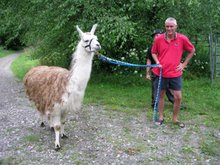
The next cool wildlife experience I had was while I was delivering llamas to a new home, a great home (as always) I might add. I was standing in the driveway chatting with a great animal communicator and her husband said "ohhhh look at the bobcat"... Didn't have to tell me twice, I jumped up on the wall and saw the most gorgeous cat walking down the backside of the wall about 20 foot away. The bobcat didn't seem to care, we caught a connection and it walked on down the wall out of sight ... very cool. Not as cool as the home the llamas got but pretty close.
On July 8th, you remember the story about the small bat that came in that I thought was dead, revived and have been feeding nonstop ever since? He was about the size of my thumb nail, he is 4 times that size now. I like him a lot. We reached a small milestone tonight. He normally grabs ahold of the syringe full of formula but tonight I tricked him. I put a small mealworm in front of him instead. He ate it ... I was shocked. Did it again, ate half of another before he realized what was going on ... had a fit and begged for his formula by vibrating and showing his new little fangs. They grow up so fast.
I am not a hero but very few people realize what I do. I have spent 5 weeks of my life on a baby bat and it is working. Andy and I agreed that it takes about 20 kids to do what I do everyday while Im teaching.
I got a baby pigeon in tonight that has issues, I have tube fed lots of them; this little guy needs your prayers; wings are fine but I think that it has two broken legs ... may be his last night. JAMES HERRIOT, one of my favorite authors said that all creatures, great and small, the Lord God loves them all ... or something close, it is late. Everyone should email John Katz, one of my other favorite authors. Tell him to get down to Middleburgh and see what I do, I need his help writing a book. That will be a big milestone but I am ready.
I will start blogging again daily, just need to get my head above water again,
Wes
Tomorrow the Workforce Solutions Kids will be done working at NY Wildlife Rescue Facility . It will finish the summer. I haven't gotten the dreaded "Welcome Back" to school letter from my boss that officially ends my summer but I do want to state for the record that I love all of you kids... I don't like the word kid, you're not ... what you have done here is amazing. Andy (the college supervisor here this summer) is amazing. Although we didn't get everything done that I wanted to do this summer, it was more than productive. Tomorrow after our BBQ, I'm sure that I will have more to say.
I actually had two weird wildlife experiences happen to me since I last blogged. I always blog how people shouldn't be quick to pounce on wildlife. I was mowing up at the picnic area and something ran in front of the lawn mower. I thought to myself, "I cant even mow without saving something ... read your blog ... leave it alone". I watched it for awhile until it disappeared in to the brush, then I saw it again in a completely different part of the area. I stopped the lawn mower, as I was chasing the chick around. I heard peep, peep, peep from all over the area. Then I saw the big hen fly in and I hid behind a brush patch as I heard cluck, cluck, cluck and all the chicks I had scattered when pulling into the picnic area come running out to get reunited with the hen and walk off into the woods.... I need to practice what I preach.
The next cool wildlife experience I had was while I was delivering llamas to a new home, a great home (as always) I might add. I was standing in the driveway chatting with a great animal communicator and her husband said "ohhhh look at the bobcat"... Didn't have to tell me twice, I jumped up on the wall and saw the most gorgeous cat walking down the backside of the wall about 20 foot away. The bobcat didn't seem to care, we caught a connection and it walked on down the wall out of sight ... very cool. Not as cool as the home the llamas got but pretty close.
On July 8th, you remember the story about the small bat that came in that I thought was dead, revived and have been feeding nonstop ever since? He was about the size of my thumb nail, he is 4 times that size now. I like him a lot. We reached a small milestone tonight. He normally grabs ahold of the syringe full of formula but tonight I tricked him. I put a small mealworm in front of him instead. He ate it ... I was shocked. Did it again, ate half of another before he realized what was going on ... had a fit and begged for his formula by vibrating and showing his new little fangs. They grow up so fast.
I am not a hero but very few people realize what I do. I have spent 5 weeks of my life on a baby bat and it is working. Andy and I agreed that it takes about 20 kids to do what I do everyday while Im teaching.
I got a baby pigeon in tonight that has issues, I have tube fed lots of them; this little guy needs your prayers; wings are fine but I think that it has two broken legs ... may be his last night. JAMES HERRIOT, one of my favorite authors said that all creatures, great and small, the Lord God loves them all ... or something close, it is late. Everyone should email John Katz, one of my other favorite authors. Tell him to get down to Middleburgh and see what I do, I need his help writing a book. That will be a big milestone but I am ready.
I will start blogging again daily, just need to get my head above water again,
Wes
Saturday, July 4, 2009
Open House July 18th
That is right folks, the moment that you have all been waiting for. You are all invited to our Raptor Center (phase one) Dedication on Saturday, July 18th between 4-6 pm. Bring your family and friends to see what your support and donations have helped build. Meet the animals and tour the facility. We might even have some cookies and punch. I am really proud and excited what a bunch of friends have done after work and on weekends.
Your continued generosity will keep the construction going on our Raptor Flight (phase two) addition to our 100 feet of individual species aviaries. None of this would have been possible without you. I am just a guy with a dream of building one of the largest not for profit animal rescue facilities in the Northeast. I've dedicated my life to achieving that goal, if you have been here you know what I'm doing. If you haven't seen it for yourself, now is the time. I also have another favor to ask: forward this blog to everyone in your address book. Tell your friends and family to check out our website www.redmaplefarm.net. This doesn't cost a dime and getting the word out about us is key to our mission.
What a great day at NY Wildlife Rescue . I had a Starling come in this am. They are fun to rehab. I also had another baby Kestrel falcon come in, this fledgling ate 3 mice almost instantly and went right out to join the other Kestrels in the Raptor Center. We had lots of BOD members stop by. Our great friend and Times Union blogger Teri Conroy stopped by to see the alpacas that I brought in a couple of weeks ago. Teri and her daughter Hannah took one of the alpacas home in the back seat of her truck. Teri and Hannah have been long time supporters of my animal rescue efforts, all the way back to when they got their first llamas from us ... back when we were just saving domestics and exotics. Teri is a great friend and it was great to put her first alpaca in her barn.
I am going to cut it short tonight. It is already pushing 1 am and I still need to try to figure out how to get on Facebook and send out a blanket email to everyone in my address book. I wish that I wasn't so computer illiterate.
Till tomorrow,
Wes
Your continued generosity will keep the construction going on our Raptor Flight (phase two) addition to our 100 feet of individual species aviaries. None of this would have been possible without you. I am just a guy with a dream of building one of the largest not for profit animal rescue facilities in the Northeast. I've dedicated my life to achieving that goal, if you have been here you know what I'm doing. If you haven't seen it for yourself, now is the time. I also have another favor to ask: forward this blog to everyone in your address book. Tell your friends and family to check out our website www.redmaplefarm.net. This doesn't cost a dime and getting the word out about us is key to our mission.
What a great day at NY Wildlife Rescue . I had a Starling come in this am. They are fun to rehab. I also had another baby Kestrel falcon come in, this fledgling ate 3 mice almost instantly and went right out to join the other Kestrels in the Raptor Center. We had lots of BOD members stop by. Our great friend and Times Union blogger Teri Conroy stopped by to see the alpacas that I brought in a couple of weeks ago. Teri and her daughter Hannah took one of the alpacas home in the back seat of her truck. Teri and Hannah have been long time supporters of my animal rescue efforts, all the way back to when they got their first llamas from us ... back when we were just saving domestics and exotics. Teri is a great friend and it was great to put her first alpaca in her barn.
I am going to cut it short tonight. It is already pushing 1 am and I still need to try to figure out how to get on Facebook and send out a blanket email to everyone in my address book. I wish that I wasn't so computer illiterate.
Till tomorrow,
Wes
Wednesday, May 27, 2009
Birds Everywhere
Mother nature has set her clock. Right now it is saying half past get out of your shell or you will never survive winter. We have been getting lots of fledgling birds in. Last night after school I had to run to the vets office to pick up a starling that was a toy for someones cat. Got the poor bird settled in, hydrated, stabilized, started feeding (ever 20 min's) ... didn't look good, went to bed warm, content and full of food ... died in the night.
I try not to focus too much on the animals that die. Learn from your mistakes, realize that you can not save everything and be humble. I learned this the hard way with a bunch of merganser ducklings last spring. I thought I could save any animal brought to me ... they are really tough ducks to keep alive. All Wildlife Rehabbers that have ever had a box of the adorable little time bombs brought to them knows exactly what I am writing about.
I have 2 robins coming in tonight after school. I found (caught would be a better description since the bird was probably completely fine on the ground, being fed by parents after flying out of the nest) a baby robin when I was around 8 yrs old. I kept it alive (illegally, I didn't know any NYS/Federal laws) ... and then my cat ate it upon release.
I like our cats, you probably like yours. Do you know that they are the biggest predator to wildlife there is? Feral cats kill more songbirds every year than anything else. Please supervise your cats time outdoors or keep them indoors. This time of year is when the baby birds are fledgling, leaving the nest and are very vulnerable on the ground. If your cat brings one home or is playing with one in the yard. Take the cat indoors, check over the bird for serious injuries, leave alone in a safe spot out of the sun and observe to see (once things calm down) if the parents continue feeding it.
I didn't have much time to help Chris on the Raptor Center last night. I received a phone call on a Turkey Vulture near Delhi, NY that was found in a hedge row in bad shape. Its wings do not appear broken but it looks like both legs are: possibly shot. Lots of maggots. By the time we got him transported, splinted and stabilized it was pushing midnight.
The vet will determine the fate of this bird. It is often more humane to put a raptor (hawk, owl falcon) to sleep than it is to keep it alive with a very serious disability. A lot of people target vultures because they are "ugly". I was watching 27 vultures the other evening soar around the Schoharie Valley. They were not even flapping their wings, they were just riding the wind thermals for hours ... very cool and FEDERALLY protected by law I might add.
I am sure that something else besides the robins will come in tonight, I will let you know tomorrow.
The little coon is doing better. She doesn't nurse like the other kits I have had for weeks. She rolls around, plays with my hand with her back feet and often nurses on her back. She is a noisy little character which still amazes me that she survived. She isn't out of the woods yet; if she survives she will find herself back in there one day.
I also want to remind everyone that feeds the Hummingbirds that they need to change their feed often. Every 3 days at the most on hot days the nectar solution needs to be changed. Old solution will make them sick. If you are lucky like us and get so many Hummingbirds that they empty your feeders every 1-2 days, it makes keeping it fresh easy.
If you wish to make your own hummingbird food, follow the instructions of the National Audubon Society and be sure to boil well to destroy bacteria, then cool the solution before feeding:
Till tomorrow,
Wes
I try not to focus too much on the animals that die. Learn from your mistakes, realize that you can not save everything and be humble. I learned this the hard way with a bunch of merganser ducklings last spring. I thought I could save any animal brought to me ... they are really tough ducks to keep alive. All Wildlife Rehabbers that have ever had a box of the adorable little time bombs brought to them knows exactly what I am writing about.
I have 2 robins coming in tonight after school. I found (caught would be a better description since the bird was probably completely fine on the ground, being fed by parents after flying out of the nest) a baby robin when I was around 8 yrs old. I kept it alive (illegally, I didn't know any NYS/Federal laws) ... and then my cat ate it upon release.
I like our cats, you probably like yours. Do you know that they are the biggest predator to wildlife there is? Feral cats kill more songbirds every year than anything else. Please supervise your cats time outdoors or keep them indoors. This time of year is when the baby birds are fledgling, leaving the nest and are very vulnerable on the ground. If your cat brings one home or is playing with one in the yard. Take the cat indoors, check over the bird for serious injuries, leave alone in a safe spot out of the sun and observe to see (once things calm down) if the parents continue feeding it.
I didn't have much time to help Chris on the Raptor Center last night. I received a phone call on a Turkey Vulture near Delhi, NY that was found in a hedge row in bad shape. Its wings do not appear broken but it looks like both legs are: possibly shot. Lots of maggots. By the time we got him transported, splinted and stabilized it was pushing midnight.
The vet will determine the fate of this bird. It is often more humane to put a raptor (hawk, owl falcon) to sleep than it is to keep it alive with a very serious disability. A lot of people target vultures because they are "ugly". I was watching 27 vultures the other evening soar around the Schoharie Valley. They were not even flapping their wings, they were just riding the wind thermals for hours ... very cool and FEDERALLY protected by law I might add.
I am sure that something else besides the robins will come in tonight, I will let you know tomorrow.
The little coon is doing better. She doesn't nurse like the other kits I have had for weeks. She rolls around, plays with my hand with her back feet and often nurses on her back. She is a noisy little character which still amazes me that she survived. She isn't out of the woods yet; if she survives she will find herself back in there one day.
I also want to remind everyone that feeds the Hummingbirds that they need to change their feed often. Every 3 days at the most on hot days the nectar solution needs to be changed. Old solution will make them sick. If you are lucky like us and get so many Hummingbirds that they empty your feeders every 1-2 days, it makes keeping it fresh easy.
If you wish to make your own hummingbird food, follow the instructions of the National Audubon Society and be sure to boil well to destroy bacteria, then cool the solution before feeding:
http://www.audubon.org/bird/at_home/bird_feeding/hum_feeders.html
Fill the feeders with sugar water, made by combining four parts hot water to one part white sugar, boiled for one to two minutes. NEVER use honey, which promotes the growth of harmful bacteria, or artificial sweeteners. Also avoid red food coloring.
Till tomorrow,
Wes
Subscribe to:
Posts (Atom)