Well, I should have more to say ... here we go.
Tomorrow the Workforce Solutions Kids will be done working at NY Wildlife Rescue Facility . It will finish the summer. I haven't gotten the dreaded "Welcome Back" to school letter from my boss that officially ends my summer but I do want to state for the record that I love all of you kids... I don't like the word kid, you're not ... what you have done here is amazing. Andy (the college supervisor here this summer) is amazing. Although we didn't get everything done that I wanted to do this summer, it was more than productive. Tomorrow after our BBQ, I'm sure that I will have more to say.
I actually had two weird wildlife experiences happen to me since I last blogged. I always blog how people shouldn't be quick to pounce on wildlife. I was mowing up at the picnic area and something ran in front of the lawn mower. I thought to myself, "I cant even mow without saving something ... read your blog ... leave it alone". I watched it for awhile until it disappeared in to the brush, then I saw it again in a completely different part of the area. I stopped the lawn mower, as I was chasing the chick around. I heard peep, peep, peep from all over the area. Then I saw the big hen fly in and I hid behind a brush patch as I heard cluck, cluck, cluck and all the chicks I had scattered when pulling into the picnic area come running out to get reunited with the hen and walk off into the woods.... I need to practice what I preach.
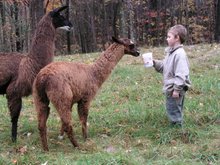
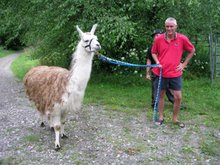
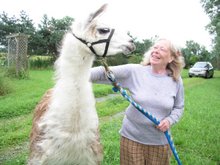
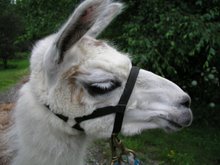
The next cool wildlife experience I had was while I was delivering llamas to a new home, a great home (as always) I might add. I was standing in the driveway chatting with a great animal communicator and her husband said "ohhhh look at the bobcat"... Didn't have to tell me twice, I jumped up on the wall and saw the most gorgeous cat walking down the backside of the wall about 20 foot away. The bobcat didn't seem to care, we caught a connection and it walked on down the wall out of sight ... very cool. Not as cool as the home the llamas got but pretty close.
On July 8th, you remember the story about the small bat that came in that I thought was dead, revived and have been feeding nonstop ever since? He was about the size of my thumb nail, he is 4 times that size now. I like him a lot. We reached a small milestone tonight. He normally grabs ahold of the syringe full of formula but tonight I tricked him. I put a small mealworm in front of him instead. He ate it ... I was shocked. Did it again, ate half of another before he realized what was going on ... had a fit and begged for his formula by vibrating and showing his new little fangs. They grow up so fast.
I am not a hero but very few people realize what I do. I have spent 5 weeks of my life on a baby bat and it is working. Andy and I agreed that it takes about 20 kids to do what I do everyday while Im teaching.
I got a baby pigeon in tonight that has issues, I have tube fed lots of them; this little guy needs your prayers; wings are fine but I think that it has two broken legs ... may be his last night. JAMES HERRIOT, one of my favorite authors said that all creatures, great and small, the Lord God loves them all ... or something close, it is late. Everyone should email John Katz, one of my other favorite authors. Tell him to get down to Middleburgh and see what I do, I need his help writing a book. That will be a big milestone but I am ready.
I will start blogging again daily, just need to get my head above water again,
Wes
Showing posts with label llama rescue. Show all posts
Showing posts with label llama rescue. Show all posts
Thursday, August 13, 2009


Tuesday, May 19, 2009
Short Weekends
I am annoyed. Just wrote a blog update and lost it in cyber space when I went to put it up on the website. I hate the fact that I am so clueless with technology. The next trick will be seeing if I can remember what I wrote. :)
Weekends are too short. Wouldn't it be cool if weekends were 5 days and you only had to go to work 2 days a week? I would get a lot more done at NY Wildlife Rescue Center but I can't complain; I love my day job teaching.
This past Friday, as soon as I got home from school, Chris and I went on a rescue. We took my daughter Hannah and her friend Katie. Hannah loves going on rescues with me and could easily run the farm since she has been looking over my shoulder for the last 12 years. The first stop was to pick up a donkey, a llama (who is getting gelded tomorrow), 4 chickens and 4 rabbits. Once we got everything on the trailer (which is a story in itself) we got them all back to the facility to get settled in.
BOD Member and fellow wildlife rehabber Linda agreed to send her husband (and animal chauffer) Dan to pick up a crow for me in Schenectady. Linda and Dan are great, Dan has helped me out too many times to count by picking up and dropping off animals where they need to be when I am too busy to get mobile. The crow has a broken wing so we took it from Linda's directly to Kelly's and I helped her wrap it until she could get it to the vets. Linda also sent along a baby field mouse that had gotten dropped off to her. I passed that on to Kelly as well. All Creatures Great and Small ... I guess :)
[Continuation copied here as well, to make it easier for our readers to follow....]
I'm not even going to try to retrieve it anymore, maybe Gayle can piece these together but this will work for me. Saturday was a productive day. We got another (very expensive) lumber delivery Friday so we were ready to go.
Chris Bevins and Paul Gillespie (from the GE Wildlife Committee) were here bright and early to get to work on the inside part of the Raptor center. Chris has been worth his weight in gold to this project. None of it would be done if it wasn't for him. He has been coming up every night after work to help me and has gone above and beyond being a good friend. Paul has donated so many hours here helping us that I have lost track. GE is really lucky to have him as an employee.
The GE Wildlife Committee has been very supportive of our cause both financially and with their volunteer labor. We need monetary donations to keep going but the volunteers are vital for keeping the non stop construction going also.
Joe and Michelle came to help in the afternoon and between the five of us, we got the other six raptor aviaries framed out and just about ready for the slots. It was a fourteen hour day and we accomplished the work of ten people.
I originally thought that the Raptor Center would be lucky if it had hawks, owls or falcons in it by fall. I want to have a dedication ceremony and Open House in June to try to hopefully raise some donations to get the rehab exercise flight construction going.
Sunday was Shearing Day. We had 25 llamas and 40 sheep that needed to be sheared. Chris and Michelle were at the facility bright and early. Our shearer Ray Baitsholts [797-5201] and his wife Cheryl (another BOD Member) were not far behind. Lori Spiers and the Middleburgh Girl Scout Troop 2006 (Destiny, Sidney, Meghan) got sheep catching duty.
The sheep were pre-caught Saturday night before it rained and locked up for the night so they didn't get wet. It is tough to shear wet sheep.
As the girls got the sheep to Ray, once sheared they passed them off to me. Just when I thought that no one ever reads these blogs, Grant and Janet showed up. They said they read on my blog that I needed help on shearing day and they were here to volunteer. We had never met but we got to know one another as we wormed, trimmed feet, banded tails and gave every sheep a NYS eartag for future ID.
We worked right through lunch, finished the sheep, and then set up the chutes to run the llamas through for shearing. We had never done the llama herd this way but it worked as well as I thought it would and by dinner time every animal on the farm (that needed it) had gotten a haircut, worming, manicure, etc.
I really want to thank the Girl Scouts, my high school volunteers, my friends and everyone that stopped by who were put to work. Many hands do make light work and I appreciate everyone who volunteers at the facility to tackle these huge projects that I have taken on. The days of being a one man army are over.
As everyone was ready for a shower and a nap, we loaded 3 llamas into Steve and Karen's trailer for their departure to their new home. I love watching animals leave to go to their new homes. I wish that I could keep them all but that isnt practical or my destiny.
WANTED- Homes with caring and compassionate people that want to adopt llamas, sheep, goats for a long term commitment. You must agree to provide for all of their needs and if it ever doesn't work out, they must be returned to our facility. We have put a lot of time and money into getting these sheep and llamas ready for adoption and they are ready to start going to their new homes as approved. Spread the word.... I would love to see many of these llamas stay together and go to homes with other llamas and/or sheep. Email me, we can schedule an appointment for a visit for "Llamas 101". Grant and Janet, I already have three weanlings picked out for you. I will teach you how to finish their halter training ... I can't wait to put some llamas in your life.
It is getting late and I am hoping that this goes to the blog this time. Till next time, feel free to volunteer, send a check for what you can afford or stop by and have a cup of coffee and enjoy the view.
Wes
Weekends are too short. Wouldn't it be cool if weekends were 5 days and you only had to go to work 2 days a week? I would get a lot more done at NY Wildlife Rescue Center but I can't complain; I love my day job teaching.
This past Friday, as soon as I got home from school, Chris and I went on a rescue. We took my daughter Hannah and her friend Katie. Hannah loves going on rescues with me and could easily run the farm since she has been looking over my shoulder for the last 12 years. The first stop was to pick up a donkey, a llama (who is getting gelded tomorrow), 4 chickens and 4 rabbits. Once we got everything on the trailer (which is a story in itself) we got them all back to the facility to get settled in.
BOD Member and fellow wildlife rehabber Linda agreed to send her husband (and animal chauffer) Dan to pick up a crow for me in Schenectady. Linda and Dan are great, Dan has helped me out too many times to count by picking up and dropping off animals where they need to be when I am too busy to get mobile. The crow has a broken wing so we took it from Linda's directly to Kelly's and I helped her wrap it until she could get it to the vets. Linda also sent along a baby field mouse that had gotten dropped off to her. I passed that on to Kelly as well. All Creatures Great and Small ... I guess :)
[Continuation copied here as well, to make it easier for our readers to follow....]
I'm not even going to try to retrieve it anymore, maybe Gayle can piece these together but this will work for me. Saturday was a productive day. We got another (very expensive) lumber delivery Friday so we were ready to go.
Chris Bevins and Paul Gillespie (from the GE Wildlife Committee) were here bright and early to get to work on the inside part of the Raptor center. Chris has been worth his weight in gold to this project. None of it would be done if it wasn't for him. He has been coming up every night after work to help me and has gone above and beyond being a good friend. Paul has donated so many hours here helping us that I have lost track. GE is really lucky to have him as an employee.
The GE Wildlife Committee has been very supportive of our cause both financially and with their volunteer labor. We need monetary donations to keep going but the volunteers are vital for keeping the non stop construction going also.
Joe and Michelle came to help in the afternoon and between the five of us, we got the other six raptor aviaries framed out and just about ready for the slots. It was a fourteen hour day and we accomplished the work of ten people.
I originally thought that the Raptor Center would be lucky if it had hawks, owls or falcons in it by fall. I want to have a dedication ceremony and Open House in June to try to hopefully raise some donations to get the rehab exercise flight construction going.
Sunday was Shearing Day. We had 25 llamas and 40 sheep that needed to be sheared. Chris and Michelle were at the facility bright and early. Our shearer Ray Baitsholts [797-5201] and his wife Cheryl (another BOD Member) were not far behind. Lori Spiers and the Middleburgh Girl Scout Troop 2006 (Destiny, Sidney, Meghan) got sheep catching duty.
The sheep were pre-caught Saturday night before it rained and locked up for the night so they didn't get wet. It is tough to shear wet sheep.
As the girls got the sheep to Ray, once sheared they passed them off to me. Just when I thought that no one ever reads these blogs, Grant and Janet showed up. They said they read on my blog that I needed help on shearing day and they were here to volunteer. We had never met but we got to know one another as we wormed, trimmed feet, banded tails and gave every sheep a NYS eartag for future ID.
We worked right through lunch, finished the sheep, and then set up the chutes to run the llamas through for shearing. We had never done the llama herd this way but it worked as well as I thought it would and by dinner time every animal on the farm (that needed it) had gotten a haircut, worming, manicure, etc.
I really want to thank the Girl Scouts, my high school volunteers, my friends and everyone that stopped by who were put to work. Many hands do make light work and I appreciate everyone who volunteers at the facility to tackle these huge projects that I have taken on. The days of being a one man army are over.
As everyone was ready for a shower and a nap, we loaded 3 llamas into Steve and Karen's trailer for their departure to their new home. I love watching animals leave to go to their new homes. I wish that I could keep them all but that isnt practical or my destiny.
WANTED- Homes with caring and compassionate people that want to adopt llamas, sheep, goats for a long term commitment. You must agree to provide for all of their needs and if it ever doesn't work out, they must be returned to our facility. We have put a lot of time and money into getting these sheep and llamas ready for adoption and they are ready to start going to their new homes as approved. Spread the word.... I would love to see many of these llamas stay together and go to homes with other llamas and/or sheep. Email me, we can schedule an appointment for a visit for "Llamas 101". Grant and Janet, I already have three weanlings picked out for you. I will teach you how to finish their halter training ... I can't wait to put some llamas in your life.
It is getting late and I am hoping that this goes to the blog this time. Till next time, feel free to volunteer, send a check for what you can afford or stop by and have a cup of coffee and enjoy the view.
Wes
Tuesday, March 17, 2009
Rescue News: Nineteen Llama Newcomers
There are good days and there are bad days when you run an animal rescue facility.  When I received the phone call from some folks 6 hours away that were having a tough time with the bank and needed to find a home immediately for 19 llamas I didn't think no ... I thought what am I going to have to do to pull this off?  I've been on bigger rescues, I've driven longer distances to save animals.  The details are always the toughest to work out. The first thing that I started thinking about was: where was I going to borrow a larger trailer to get them all in one trip. My trailer is too small to carry 19. The next thing that I was thinking: what muscle could I get to road trip with me; since there was no way I was going to wrestle 19 wild llamas in the trailer by myself?   I found the trailer, Justin and Chris were up for an adventure--plans were made to take off for our mission at midnight on Friday night.

We arrived at 6am as planned to get the llamas. I was hoping that they would be locked in the barn ... we could back the trailer up and be home bound by 7am Saturday morning. Llamas are an amazingly intelligent animal and have the unbelievable ability to foil the best of plans. Due to the fact that we've done this a couple of times, Justin and I had everyone on the trailer and we were back on the road with two heartbroken people standing in the driveway waving their goodbyes. It didn't take me long to figure out that these were not your normal llamas. They were in good shape but over half the herd stood for the entire six hour trip back home; very odd and not something that I've ever seen before. Normally as soon as the trailer starts moving the llamas kush (or lay down) but these llamas were not making anything easy or normal.

We arrived back to the farm slightly behind schedule and really happy to be back. I decided that while the llamas were still on the trailer that they should get their worming shots. That went as I expected it would, it was not on the top of the llamas' list of things to do after a long ride but it had to get done.  Now the fun part. I don't let intact male llamas out with the herd until they have been gelded.
Supposedly there were five intact males running with this herd.  I started letting them off the trailer and running them down through the barn through a series of locks where I could sort off the males into pens and let the females out into the herd. My daughter Hannah (who is 12 and has rescued more animals with me than most animal shelters have) quickly volunteered for the Easter egg hunt and we quickly had seven males identified and separated. The one six month old male cria got a reprieve and got to go back out with his mom and the herd ... this still left us with six males, not five.

The females with their crias (most likely rebred) have adjusted well over the last couple of days. They like their new mountain view and they are starting to settle in. They do not want to sleep in the barn and prefer to sleep out in the middle of a 10 acre pasture. I am starting to get into their heads and get to know them.   You really don't have to be an animal communicator to pick up on their vibes.  They know that I won't hurt them and they know that I helped them but they are very nervous and you can feel that they haven't settled into their new home yet. They are confused, don't understand why they are here and really would like to be someplace that they are more familiar with. If they only knew what their fate could have been.
They have a lot ahead of them. They will be given the time that they need to settle in before I start halter breaking them. The first of the biggest two obstacles are over.

The males are the next hurdle. They need to be gelded before they can be let out of their pens to rejoin the herd that they have lived with their entire lives.  I need to raise at least another $1000 to cover the vet bill for their surgeries. We have received enough donations to cover the transportation costs.  Our facility has grown a lot over the last 10 years. I can no longer afford to pay for everything out
of my checkbook as a teacher. We have to rely on donations because my vets won't come for free. :)  I have never been good at begging for money.  We have become a not for profit facility now (not like any rescue facility ever makes a profit).  The nice thing about this is that people that donate money to us can write it off as a tax deduction. I am hoping that we can raise the money to cover the geldings this week so that I can get the vets here. Once the males are gelded, we can handle the rest of their care, worming shots, vet visits, feed, shearing, training, etc.  We have never turned an animal in need away and I don't intend to start saying no anytime soon. I really am flattered that so many of our supporters have sent a check. It really validates what we do that other people support us.  As soon as we get the  guys gelded and everyone gets settled in, I would love to teach anyone that would like to learn how to halter break a llama a few of my tricks to do that.

Tomorrow I will try to write a blog on all of the wildlife that we have taken in over the last couple of months. It is my intention to get blogging again so that our friends and supporters can see what is coming in on a weekly basis and hear the story of those animals as well. Sometimes there just isn't enough time in the day for the computer when I would really rather be in the barn with the animals.

Till the next update,
Wes


Support NY Wildlife Rescue Center!
Main site: www.redmaplefarm.net
Blog: www.northeastllamarescue.blogspot.com
Giftshop: www.cafepress.com/NYWildlife
Subscribe to:
Posts (Atom)