Please also see our other blog at

http://nywildliferescue.blogspot.com/

It is more active than this one. Always check there for updates, too.


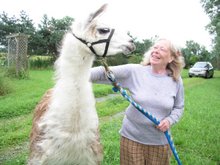
Northeast Llama Rescue was started by Wes and Darcy Laraway of Middleburgh, NY.

Several years ago they rescued their first llama out of a tiny horse pen. Since that day, Northeast Llama Rescue has helped dozens of Camelids from several different states.
The primary mission of Northeast Llama Rescue is to educate owners on how to properly care for their animals.

We also offer assistance with a traveling chute to shear, worm, and trim toenails on hard to handle animals. A 'TRUE REPUTABLE BREEDER" should help out the llama down the road that is not being cared for by owners that understand the needs of llamas.

If you know of a llama owner who is no longer able to care for their animals, there is help available. Members of Northeast Llama Rescue will adopt any unwanted animals. Rescue animals will be relocated to farms of members for training and necessary vet work.

If a llama is able to be rehabilitated, he will be available after a careful screening process. All rescues are placed in homes with a contract that says they shall be provided for and can not be sold. In the event a rescue animal becomes unwanted, the llama MUST be returned to Northeast Llama Rescue.

If you share our philosophy and love for the animals, you are more than welcome to join us! There are lots of llamas that need a person to love.

We also rescue farm animals, and are licensed wildlife rehabilitators.

This site is copyrighted by Wes Laraway.

Wednesday, January 19, 2011

Montana Llama Crisis

Important: Please see our other blog at
http://nywildliferescue.blogspot.com/

for more updates on this situation!
You may wish to bookmark and follow that blog,
as it is the more active one.


Hi Folks, We've been really busy since I blogged 10 days ago. Yesterday, 100 llamas were loaded on a huge semi trailer by Zeigler Transport in Montana. 10 days of nonstop work with the Camelid Rescue Coalition got 100 gelded llamas headed to us. There are still 200-250 llamas left in Montana. It cost over $9000- just for the transport of these 100 to NY. Donations have never been so important. I really hope that the other 200-250 can find a home before the rescue group that is in Montana leaves on Jan 31st.... I know one thing, we dont want any more than 100. This is one of the largest animal rescues in the USA since Hurricane Katrina. It is a huge undertaking by all involved. Thanks to all who already donated. Thanks to my BOD that have worked day and night to ccordinate all of this. I really want to thank Bruce, Eric and Judder. These 3 guys are the core of our volunteers and have helped me do almost everything over the last week around the farm to get ready for their arrival. Ellen has been vital to the coordination. Gayle has been vital to keeping the website and paperwork straight...to the dozens of donors, your donations have given us the faith thgat we can do one of the largest animal rescues in the USA and still pay the bills.....I will try to blog daily again or as I find out new news and/or get photos. Weve had two bats come in this week. besides for the little brown bats, things have been slow but it won't be for long. One person can make a difference, many people can make a bigger difference.:) WES


Trailer that is bringing the 100 llamas to NELR/NYWRC

Friday, January 7, 2011

Emergency Transport for 50 Llamas

IMPORTANT ALERT!

A Montana sanctuary is closing its doors. Approximately 600 animals are affected.

We at Northeast Llama Rescue have agreed to take 50 of these animals.

Funds are desperately needed for transportation!


Please Donate Now!


Thursday, March 11, 2010

Been There, Done That


After a week of nasty weather, 3 snow days from school, lots of shoveling with over 4 feet of snow....what do I say? Spring is coming, my friends are boiling maple sap right now to make syrup. 36 gallons of sap to make one gallon of syrup. The snow is slowly melting (TG), I've seen robins in the yard for weeks, saw my first vulture returning this past weekend and I even heard a red-winged blackbird this a.m. while doing chores. I am excited about changing the clocks this weekend, spring is in the air.

Things have been slow at NY Wildlife Rescue Center lately but will pick up shortly as "orphan season" begins. January was everything that I thought it would be. I kept busy doing little projects and showing many interns from SUNY Cobleskill's Wildlife Program what we do here.

February was unproductive. My wife and kids went with their grandparents, aunt, uncle and cousins to Disney World in Orlando. I stayed home to try to get some wood cut and hold down the fort. The weather was lousy, I wish I had gone with them now. The highlight of my winter break from school was going to General Electric (with Gayle and Kelly) to do a program for their Wildlife Committee. The Whitney Club have supported us with checks and volunteer labor for years, they are good friends and we love doing our programs for them. The ride home during the blizzard was interesting but we made it, my truck really needs new tires.

March is a great month, spring is in the air. I did a Wildlife Program for the West Fulton Rod and Gun Club last week. I love speaking to hunting clubs, we have the same mission. I am all about conservation and preservation of wildlife. A good Rod and Gun Club will have the same mission statement. It was a good program and I believe that when it comes time to build the Raptor Flight their members will be there to help us. I appreciate their donation also.

This past Saturday, I did a Wildlife Program for the Golden Age Club of Middleburgh. I had a lot of fun and their lunch was great. I am surprised at how many people in the town where I grew up, live and teach don't know what we do up on the hill. I've made it my mission this spring (before things get busy again with orphaned wildlife) to get the word out locally about what we do. I will gladly speak and bring some of our licensed educational animals to any group that would like a program. I just try to keep my programs within a reasonable driving distance.

Last night I received a phone call from Cornell University's Wildlife Center. I expected that it was a call to see how Oscar the Bobcat was doing. Oscar is healing up nice but still favors the one hind leg a bit. I am still hoping that he is releasable. If he isn't, I would love to find a zoo with a native wildlife section that has a great enclosure for him but that is not a decision for today. The vet that called explained that Dr. Randell of Somers Animal Hospital has been working on another male bobcat that was hit by a car in Croton Falls NY, Westchester County. Deja Vu. I think that I've done this before. Cornell was wondering if I could help house and continue rehab on this Bobcat. The Wildlife Hospital at Cornell University offered to provide support care. I quickly agreed.

Somers Animal Hospital did a great job on this cat. Check out their website, www.somersanimalhospital.com and be sure to drop them an email thanking them for what they did to stabilize the bobcat. Many vet clinics do not want to deal with wildlife, this vet clinic went above and beyond. I am impressed: check out the bear surgery photos on their site...awesome. I agreed to help and said that I would start to figure out transportation to our facility. I instantly emailed Kim and Karen, two wildlife rehabbers that I greatly respect in the Rhinebeck area to ask if they would help with this cat. Kim and Karen were the wildlife rehabbers that caught and brought Oscar to me last year. They agreed to pick the cat up at Somers Animal Hospital and meet Roger to transport the rest of the way up to me. Roger is a new wildlife rehabilitator. He is also the man that saw Oscar laying along the road last year and stopped to see if he could be saved. He took such an interest in Oscars recovery that he visited, sent checks and took his test to become a rehabber himself this past fall at the Wildlife Rehabilitators Conference in Lake George.

Roger agreed to meet Karen, transfer this cat into his car and drive another hour to meet me at a convenience store by the Rip Van Winkle Bridge. We did that last night. I really appreciate the help from Kim, Karen and Roger. I appreciate that Kayla, one of our High School volunteers, came along with me for the ride. No one can do Wildlife Rehabilitation without a network of friends and help. They know that I would transport the other direction towards them if needed. It is easier to have 3 people drive an hour each way than force one person to make a 6 hour round trip. I still need to get a transportation chain linked between our facility to Cornell. I know that if we could shuttle raptors and wildlife easier between the Wildlife Health Center at Cornell and NY Wildlife Rescue Center that they could fix and I could rehabilitate many more animals that really don't have a place to go to heal for several months.

This new Bobcat, that I've been calling "Deja Vu" (I don't name wildlife), was pretty out of it last night. He has head trauma, a dislocated leg, and nerve damage in another leg. I don't think that Deja Vu is as messed up as Oscar was with his fractures. I got the bobcat settled in last night when we got home, he hasn't eaten in two days since the accident. Bobcats don't like commercial cat food if given a choice. I feed all of our bobcats the same defrosted dead rats that I feed the raptors. I gave him a couple last night and I didn't see the rats this morning but it was kind of hard to tell if they were in his cage or stomach with him attacking the sides of the cage. Tonight we will try some defrosted mice....yum. I like mice, they are easy to sneak his meds into.

I am excited to have the honor to save another Bobcat. I know that it is going to be expensive and time consuming but I like a challenge. I needed something to keep me busy until Orphan Season starts in another month. Now since I have something to write about, I will try to get blogging again. I will also try to get a photo of "Deja Vu" up on the blog asap, Roger took a couple last night. This bobcat is bigger than Oscar. Oscar was 17 pounds the day he was hit by a car, this bobcat is almost 24 pounds. I will also try to find out the details of the accident.

Be back soon, Thanks for your continued support.

--WES

PS: thanks to Karen LeCain for donating the pictures of "Deja Vu".


Friday, March 5, 2010

3rd Annual Easter Bunny Photo Shoot

Come join us for our 3rd annual

Fund Raising Event:

Easter Bunny Photo Shoot


Have your photo taken with a live bunny or lamb!


Where & When:

Saturday March 20th 10a.m. to 2p.m

@ Agway, Rt. 7, Cobleskill

Sunday March 21th 10a.m. to 2p.m.

@ Middleburgh Hardware, Main St, Midd


Why:

To help raise funds and awareness for the New York Wildlife Rescue Center, a local non-profit animal rescue located right here in Middleburgh.

***Please join us for a day of fun and have your photo taken with a bunny or lamb and learn something new about our local wildlife. Live Birds of Prey will also be on location for viewing and question/answer sessions. The New York Wildlife Rescue Center is a registered non profit that relies on private funding to support all of its releasable and non-releasable wildlife.


For more information please call:

518-827-7760


Thursday, January 14, 2010

Help NYWRC Help The Animals

Please vote for (name entered as:) *NY Wildlife Rehab Center* (address:) Llama Rd. Middleburgh, NY to win a grant from the Berkshire Bank's giveaway:


http://www.berkshirebank.com/about_us/in_the_community/berkshire-bank-foundation/help-us-give-away-20000

Monday, January 11, 2010

Happy New Year

Since my last blog, a lot has happened, seems like I havnt blogged since last year. I am blogging with a little Daschund Puppy sleeping on my lap, long story but she is here and needed a home... I found the Pitbull pup a home and they love her and it appears to be working out. After school on Dec 23rd, I took all of the supplies that my students brought in over to the Animal Shelter of the Schoharie Valley. Volunteers/staff helped me carry the stuff in, the kids actually got a TYN this year, Im glad that they appear to be getting their PR in order. Our County needs them and we all need to work together. I got an email today for 25 horses that need a home, 17 llamas that need a home, another 2 older horses looking for a home. Locally, people are calling me all the time to beg for help, ask me to take their animals or report people that are neglecting their animals. I wish I could help everyone and every animal but our county doesnt have an animal control officer and it seems that many law enforcement agencies are slow to get involved with animal abuse cases. They are tough to document and prosecute but shouldnt be avoided. The weather is bad, if you cant afford to feed your livestock, give them to someone that will. Cheaper in the long run than getting an attorney to try to stay out of jail. Sad yet true.....I so wish that I could do more legally. Financially this time of year is always tough for everyone. We are a not for profit looking for donations like every other animal rescue group. I never take on more animals than I know we can care for on our budget. I know that I can afford to feed the livestock that is here for the winter, I make sure the hay money is set aside before the snow flies. Just before xmas, someone nominated me as a Times Journal Star. This is an honor that our local paper does every year. It is to recognize people that have made a difference in our County for the previous year. To the people that nominated me, thank you. I am flattered and honored by the local recognition.
Xmas was everything that I thought it would be. Our kids and pets are lucky. The time with family was nice, something that we should do more often. New Years Eve was spent at home with friends and family, 2009 has disappeared and I have high hopes for 2010. Reflections on 2009 are very positive for Northeast Llama Rescue, New York Wildlife Rescue at Red Maple Farm. Every year we have all to do to keep up with the growth and need for what we are doing. We are one of the only animal rescue facilities that do what we do. Im not talking about numbers of animals helped, we helped well over 500 animals this year find new homes or get back into the wild. A feat that I am very proud of considering our limited budget. Every donation that we get goes directly into expanding our facilities to help more animals. We are basically in a state of nonstop construction to keep expanding our facilities to handle the increased numbers of animals coming in every year. 2009 was a great year. We built (and dedicated at our Open House in July) a 100 foot of Raptor Facility that is second to few. There are 8 different aviaries to handle just about all of the species in the Northeast that come in with injuries that need to be treated. There is a wide assortment of hawks, owls and falcons using this space already. It is available to any licensed rehabber. 2009 was also the year that Oscar the bobcat found his way to me. Oscar came to me because others knew I was his only hope. I may have brokered the deal but Cornell Universities Wildlife Center kept him alive, with some help from God. We built a beautiful shed and a new enclosure for Oscar to heal in. We were overwhelmed with Raccoons this year, there are very few places left that are licensed or even want to deal with them. We built a new shed just for doing them that can be sanitized and locked. I am thinking that it should hold around 50 coons as youngsters, around 20 skunks....I am really not the type of guy that likes to think about the past. I like to think about the future, 2010 will be a great year. I am determined to get the flight built off the Raptor Aviaries so we can actually fly the Raptors to get them ready for release back into the wild. This will happen with your support. Once that is done, we need to do something different with our deer soft release area. I would like to get it fenced in with 8 foot deer fencing but we will worry about that design when we get there. Im sure there will always be a project here, all I need is time and money. Till next time.....

Tuesday, December 15, 2009

'Tis the Season

'Tis the Season to be Jolly and thankful for everything we all have ... friends, family, all types of critters, wildlife rescue facilities.... You get the drift. After my last post, I had to take a little break from my blogs. I never get sick of the animals, most of the folks I meet are cool people that do what they can to help an animal, send New York Wildlife Rescue Center a donation or help us out by volunteering up here. Just a quick reminder, there are some great products for sale in our store section of our website. For those of you that like to send out the support in the form of a check, you still have about two weeks to get the checks in for this tax year deduction.

I've spent the last few weeks catching up on reports, license renewals, rehab logs, etc. My individual Wildlife Rehabilitation Log for the DEC is 40 pages of wild birds, mammals, reptiles and amphibians. My RVS intake forms for the 40 raccoons, 10 skunks and a dozen bats are over 30 pages. This year alone, my log alone has over 200 wildlife entries. Add my wife's squirrels, and what our BOD and Associated Rehabbers in our network have done, I would not be surprised at all if the total for our group is well over 500 wild animals saved this year. It is NOT a contest to see how many animals I can save. I just do what I can do and we try to do things first class not half-assed, one animal at a time. Add in our domestic pet rescues, livestock and exotic animal rescues ... wow, no wonder I'm so tired lately. Being a perfectionist, I was complaining to a friend the other day about how much more I could do and was thinking out loud about how many more animals I could save. I often wonder if I am making a difference in the world ... maybe not, but as my friend pointed out, I make a big difference to the animals and kids I help. I do know that we wouldn't have a website and a lot of paperwork wouldn't have gotten done without the help of my very good friend Gayle Nastasi, visit her website from our links, it is great and she is very talented. I am lucky to have her as a friend and on our BOD.

When I was trying to figure out what to write about tonight, I figured I would start with my standard apology for not blogging. I don't want to do a reflection on the year (yet), but looking back over the last year ... we have accomplished more than many of the animal rescue facilities that have large budgets, with taxpayer support and paid staff members. I am very proud of what we have done. If I can keep up with fundraising, facility construction, rehabbing the animals, public relations, paperwork, my job teaching, my family and my wife ... we are going to build a facility here that will be second to none and will long outlive me.

In November I attended a NYS Falconers Banquet. It was a fun time, I bid on some great items in the secret auction. Unfortunately I didn't win any of it but hey, all it takes is a dollar and a dream. Also in November, I went to the NY Wildlife Rehabilitation Council's Conference in Lake George. It was a great conference, lots of great friends, food and drink (it is my vacation also). I went to as many of the classes as I could that were on Raptors. As always, I really learned a lot and it was well worth attending. Networking is half the battle of being a good rehabber. I got to see and meet a lot of great Wildlife Rehabbers at the conferences and I learn a lot over a few drinks. I really want to encourage EVERYONE to take the test and become a wildlife rehabilitator. Remember that becoming a rehabber is one of the most rewarding things you can do. You can put as much time into it as you can afford (mentally and financially) and say no when you are in over your head. The demand is huge for new rehabbers, I believe that there are only a couple of dozen licensed RVS Rehabbers that can legally do raccoons, skunks and bats in the entire STATE of NY. My wife is like most rehabbers, she found her niche, she only does squirrels. Some rehabbers only do rabbits (only have to be fed twice a day). Some only do baby birds, every 20 minutes ... yikes.... The key to being a good rehabber is having a good mentor. If you are interested in doing this crazy thing of saving wild animals, you MUST get a good mentor. A good teacher is better than any book and you will burn out if you don't get taught right and stay on the cutting edge in new techniques for giving animals (that often want to die) some life. I've had one of the best mentors; Kelly Martin has done this for over 20 years. She is President of NY Wildlife Rehab Council and she is one of the best rehabbers that I have ever met. You can go to DEC's website, order the study materials, enroll to take the test but it is almost impossible to figure out what license you need for what animals. It is impossible to keep track of renewals, applications and logs. I am the most organized person that I ever met and I often say "I need another license for that?" or "When is that form due?" or "No wonder why no one does this...." :) A good mentor is very important to show you how to do it right and keep your sanity in the process.

I have done my required hours working with Kelly, I have the hundreds of hours needed and have received my US Fish and Wildlife Federal Migratory Bird Rehabilitation Permit now. Kelly is a great teacher, she lets me learn some things on my own and then smiles when I figure it out, she often puts on her glasses when I now know I am going to see something new, she gives me a kick in the ass when I need it or am in need of a pep talk. I am waiting to receive my own Federal Special Purpose Migratory Bird Educational License. I will be learning how to rehab animals better for the rest of my life, it will be nice to be done collecting licenses.

Kelly lost a very special Raptor this week that anyone that has ever seen our educational shows knows well. Hooter the Great Horned Owl was one of Kelly's first educational raptors, added to her federal license in 1985. Hooter would go anywhere, would sit on your fist forever and was always the bird that never got off his stand, rarely gave us a hard time ... just the dream bird that will be missed greatly by all. I'm sorry for your loss Kelly.

Enough for tonight.

Northeast Llama Rescue by Wes Laraway

The Northeast Llama Rescue was started by Wes and Darcy Laraway several years ago after they rescued their first llama out of a tiny horse pen. Since that day, the Northeast Llama Rescue has helped dozens of animals in 5 states. The primary mission of Northeast Llama Rescue is to educate owners on how to care for their animals properly. We also offer assistance with a traveling chute to shear, worm and trim toenails on hard to handle animals. If owners get "tired" of the daily maintenance of their herds, members of the Northeast Llama Rescue will adopt or buy, if possible, any unwanted animals. Rescue animals go to the farms or members of the organization.

The Northeast Llama Rescue does not wish to compete with other rescue organizations, although any llama or alpaca is welcome. We need to cooperate to help ALL camelids, not just registered or "nice-looking" ones. Everyone has the right to breed and sell llamas, but a true reputable breeder will "help out" the llama down the road that is not being cared for, regardless of its age, sex or conformation.

Our last rescue came from Central New York. A farm had purchased 9 animals from a Midwest auction. Four of the animals had died from natural causes....starvation? The owner had health problems and no longer wanted the animals. After several other concerned people failed to negotiate their sale, I eventually called and within five minutes we had agreed on a price and the deal was done. The next night, Wes Laraway, Kim Scheurerman and P.J. Wagner went to pick up the animals. The owner informed us that the llamas were wild and could not be handled. Within five minutes all were calmly caught, on lead ropes and in the trailer, with us using a wand and some TEAM Training techniques. The owner thought I was the "llama whisperer" because I got those llamas to do things in five minutes that she couldn't do in a year. She unfortunately knew nothing about handling llamas.

Three hours later, we were back into quarantine at Red Maple Farm starting "damage control". The animals were immediately wormed, fed fresh hay and grain, and watered. All were body scored under three by sight and by feeling through their wool. This hands-on inspection revealed barbed wire that needed to be cut out of the fiber. We decided NOT to shear because it was too late in the year and they were too thin.

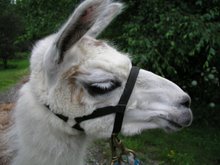
Another concern was an ingrown halter. One of the best ways to remove ingrown halters is to undo the buckle(s) and cut the nose band with sharp toenail clippers on each side of the nose. Then gradually, over time, the remaining pieces will fall out. With application of an antibiotic cream, any wounds from the ingrown halter will heal quickly. In this particular case, the halter came out of the nose and was added to the "wall of shame" in our barn (along with the barbed wire and ear tags still on them from the auction they were purchased from). The blood stream stopped within fifteen minutes and now, after a month, we can tell that scarring will be minimal. Please tell everyone you know that owns camelids, NEVER leave a halter on a llama! Even in a week, with wet conditions, a halter can embed itself in a llama's nose.

My biggest concern was the 10 month old female that was exposed to her father. If bred, we decided to abort the unborn cria for the safety and well-being of the young female. None of these five animals were over the age of three years. All of them, over the following months, would need intense care and proper nutrition. The animals were all updated on health requirements and gelded. All of these animals would need training before they could go up for adoption.

New problems continuously arose. Two weeks after they arrived, one of the females surprised us with a weak, constipated fourteen pound male cria. Within hours I knew it wasn't "normal" so mom and baby were moved to a quarantine pen in the barn. The decision was made to supplement the cria with goat colostrum and give him an enema. Although the cria was walking, he continued to strain to relieve himself. Around the clock surveillance did not reveal any nursing or defecation. At two days old, I found very small maggots between the cria's toes and by his umbilical cord. After consulting my vet again, the cria got a bath and dried out in the heated office before going back to mom in the barn. My vet explained that crias born on rainy days must be completely dry or flies will lay eggs in moist areas of umbilical fluid. I've never heard of this problem before but I know now to check my newborn crias for maggots every day. After five days of constant care, we lost "Trooper"....I guess it was not meant to be, but we tried.

The rest of the animals are doing well today. Concerned individuals found them, bought them and will protect them. Today is actually a special day, because the vet did fecals on them and all five of them are parasite free and can join our llama herd. After training and further rehabilitation, by Spring 2001 this group of animals will be available for adoption to carefully approved homes. All animals sold or placed by Northeast Llama Rescue will be adopted with a legal contract. The contract states that if the llama ever becomes unwanted or is not cared for properly, the animal will return to Red Maple Farm for a full refund. I used to think I could save every unwanted llama in the world...I know that I can't . It is too great an undertaking for one farm to rescue all the unwanted camelids out there. For this reason, several other farms have joined in the effort with Red Maple Farm to pool resources and save neglected and unwanted camelids.

Any farm that shares our philosophy that every llama deserves a life with proper care is welcome to join us. We are people who genuinely love all llamas and want to make a difference one llama at a time. Eventually we will print an educational brochure to hand out at events with member farms listed. Don't just tell people that you love your llamas; show people by making a difference and actually save one. Always quarantine new animals for at least one month while getting wormings, vaccines and nutritional needs in order. Always do a fecal exam and consult your vet about when new animals should go out with the herd. Geld all males and most of all BE PATIENT. Llamas are very forgiving animals and will learn to love and trust again with gentle care and training.